Jonathan Fennell for Collapse: A Global History of the Second World War 1931-1941
Wednesday 15th July, 7pm
Topping & Company Booksellers of Edinburgh, 2 Blenheim Place, Edinburgh EH7 5JH
6.30pm
7pm
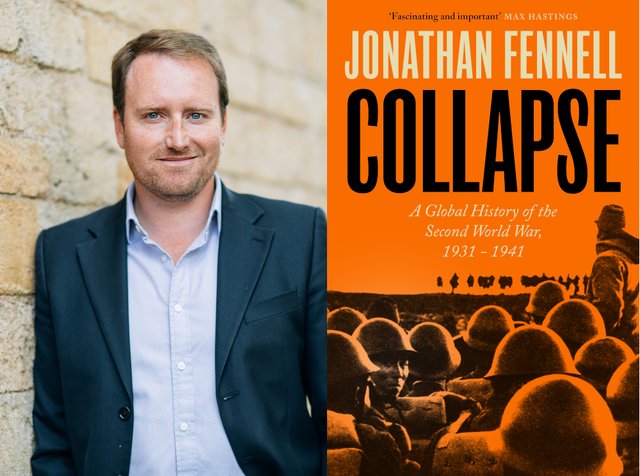
Jonathan Fennell is Professor of the History of War and Society at King's College London, where he is Director of Research at the Defence Studies Department, Co-Director of the Sir Michael Howard Centre for the History of War and Co-Founder and President of the international scholarly society, the Second World War Research Group. His most recent monograph, Fighting the People's War: The British and Commonwealth Armies and the Second World War, won the Duke of Wellington Medal for Military History 2020, and also the Society for Army Historical Research Templer Medal.
The first volume of a ground-breaking and truly global trilogy on the Second World War, from an exciting, prize-winning academic.
Between 1931 and 1949, a series of crises broke out that threatened collective security, world order and the internal cohesion of states across the globe. At the heart of these crises was a world war that shook the foundations of global power, a watershed moment in the history of the Twentieth Century. Collapse is the first volume of an authoritative trilogy that tells the story of the Second World War through this international lens, covering theatres of war in multiple continents and analysing worldwide trends.
Through exciting new sources in 14 languages and from over 50 archives across the world, Professor Jonathan Fennell examines the first part of this "long war", from 1931-1942, and explores what it really meant to live through this violent time. Using an innovative approach which explores the personal alongside the political, the global alongside the local, he shows how a world that many considered civilised collapsed into barbarity.
Through immersive storytelling and a cast of characters, from 'bands of brothers' to 'sisters in arms' and 'warwoven lovers', Collapse links the home and battle fronts and ties together the stories of great campaigns with the dramatic political and social changes of the Twentieth Century, and in doing so, transforms our understanding of this monumental conflict.